
Bear Essentials – A Framework for Closing Mental Loops

This framework turns lived experience into insight. You capture thoughts as they happen, review them weekly, and notice emerging patterns. It's what shows up when you pay attention and reflect with honesty.
I built this because I needed a way to make sense of experience without adding pressure. The goal is clarity. The practice creates space to notice patterns, close mental loops, and learn from what actually happened.
If you're new here, consider learning about the philosophy before reading on:
 Patrick
The Core Approach
Life generates the material. You don't decide topics in advance. You live normally, capture what matters, and see what emerges when you review. The patterns tell you what the week was about.
Reflection reveals meaning. Raw notes become insights through simple review and synthesis. You look for threads, spot recurring themes, and ask what changed or what you noticed.
Tools reduce friction. Bear for capture, ChatGPT for analysis, NotebookLM for additonal perspective. Simple, accessible, repeatable. Nothing expensive or complex.
How It Works
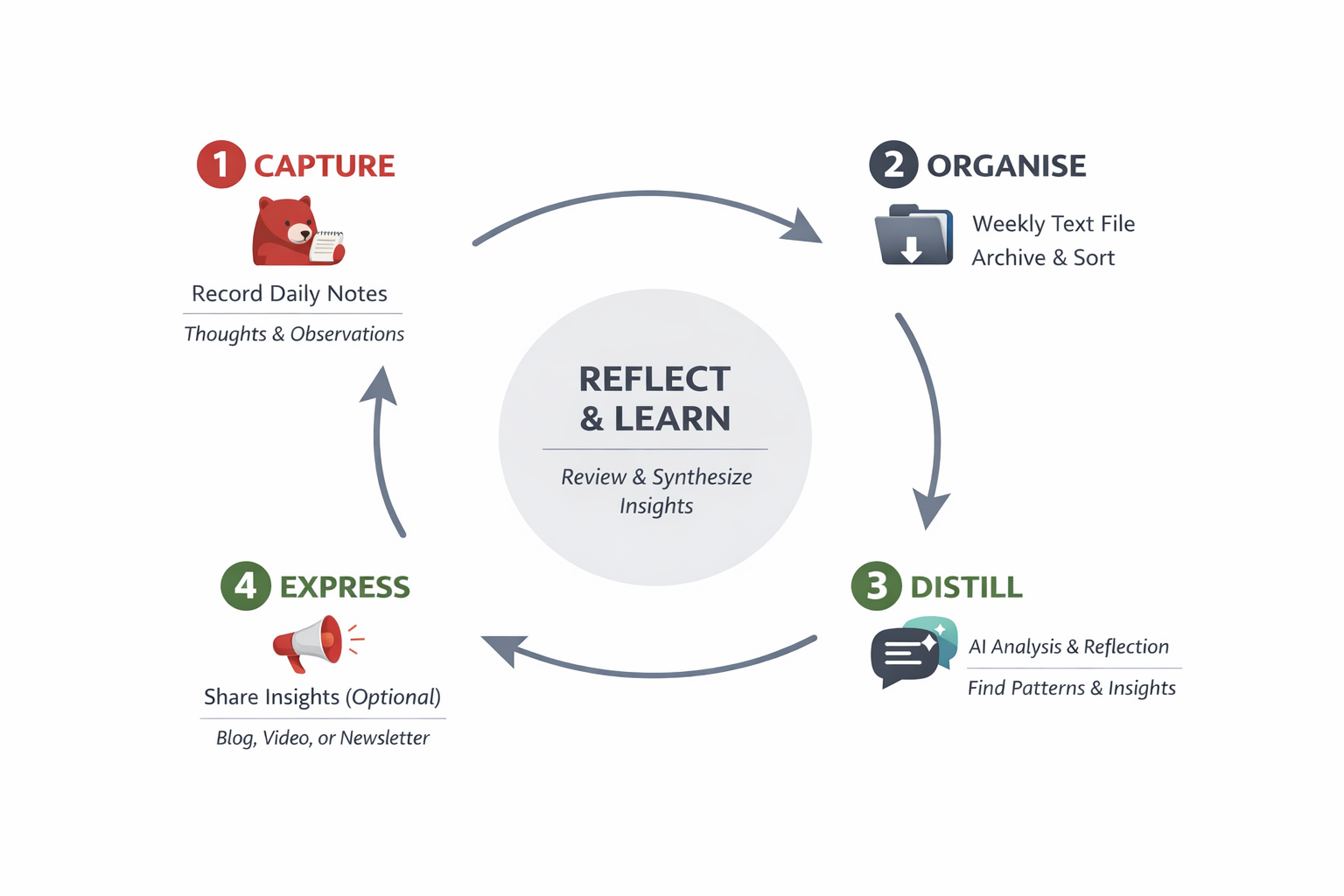
This framework follows Tiago Forte's CODE structure. Each step builds on the last. Capturing feeds organisation. Organisation is automated, feeds distillation. Distilling gives us the tools reflect express what we've learned, if we choose.
- Capture daily notes in Bear—raw, voice dictated, immediate.
- Organise notes as a weekly export into text files—tagged, archived, structured for review.
- Distill through AI analysis and human reflection—turning observations into patterns and lessons.
- Express by reflecting privately, or publicly in blog posts, videos, or newsletters—sharing insights solidifies learning.

1-Capture Throughout the Week
Although this can be adapted to use other methods, I specifically use the iOS app Bear to record thoughts, insights, and ideas as they happen. Voice dictation works well for speed and continuity. Don't worry about grammar or mistakes. The AI will pick it up and iron it out later down the line.
One thought per note. Keep it raw and immediate. Capture anything that stands out. Observations about work, creativity, energy, awareness, patterns in thinking. No polish needed. The goal is getting it out of your head.
Set up notes to automatically title themselves with the date to give it some level of structure. I choose YYYY-MM-DD-HH:mm format. This is important because we're trying to minimise friction. Thinking about what you're going to title your note slows you down. We want to capture our stream-of-consciousness in an unbroken flow.
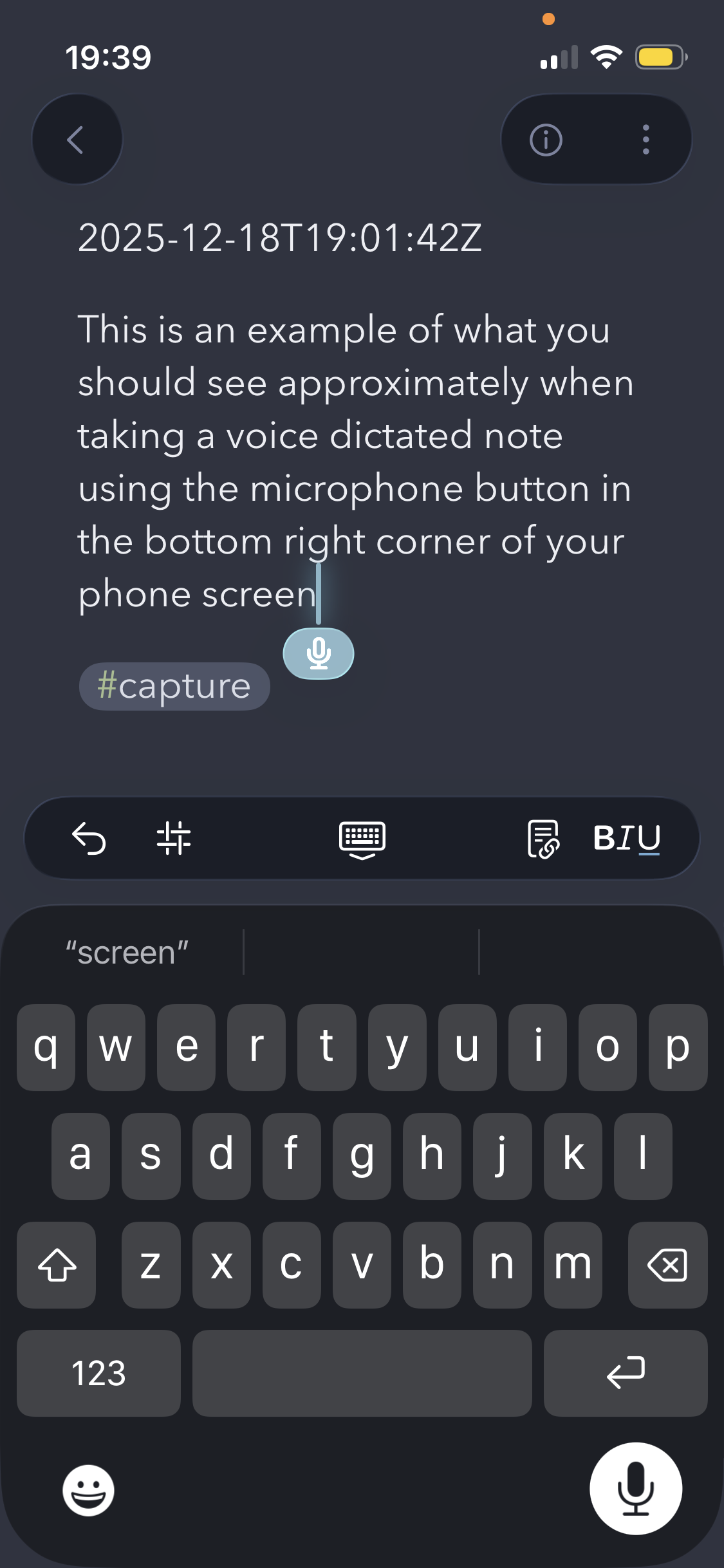
Use one tag only. Something along the lines of #capture or #inbox will work well. Here's the link to the iOS shortcut I use to get you off to a quick start. Just add it it to your pone home screen, or even better, as a widget to your lock screen, or 'action' button if you have a newer iPhone.
Get my iOS capture shortcut here.
2-Organise on Weekends
Go to your #capture tag and select all notes. Export all your Bear notes from the week and merge them into a single .txt file using the checkbox. This consolidates the week's material and prepares it for review.
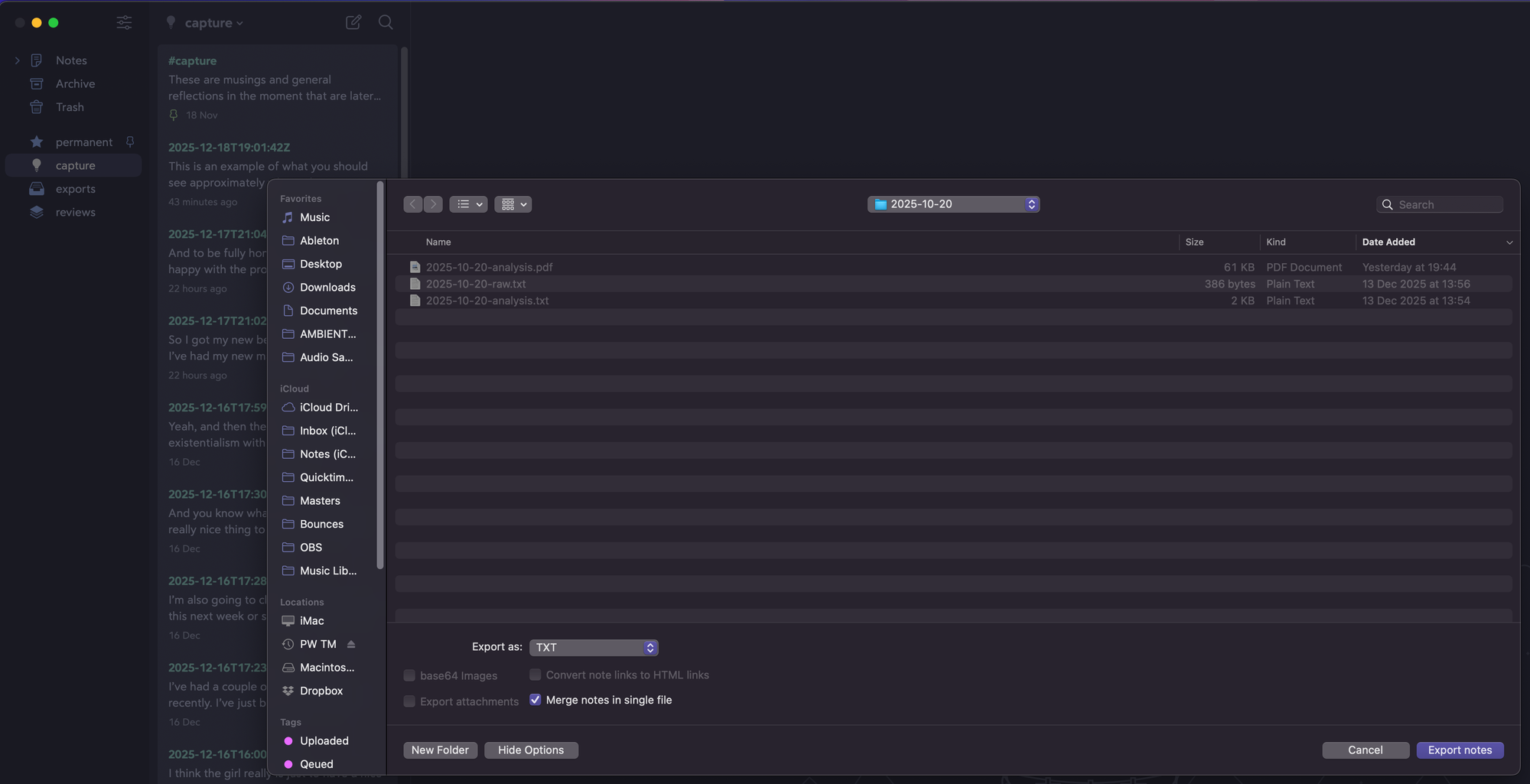
Archive the individual notes by removing the #capture tag and either adding them to Bear's built-in archive, or adding a new tag such as #exports. The latter is my preferred method.
Keep the text export and save to a folder somewhere on your device, ideally using a date referencing title such 2025-12-08. Consistent naming will help you find things with less friction later.

This process turns scattered thoughts into a single document you can work with, but it is still just the raw material we've prepared.
3-Distill Into Patterns
Feed your weekly text file into ChatGPT, or AI provider of your choice. Ask it to summarise the week, identify patterns, and pull out insights. I recommend using the same chat for uploading your notes each week. This provides some additional continuity and context.
The prompt matters. Ask for first person, active voice, concrete examples. Tell it to focus on what changed your thinking or behavior, not generic observations. This will vary for what different people are hoping to gain from this process, but this is the exact prompt I use when uploading the consolidated .txt file:
“Treat this as my weekly stream-of-consciousness. Prioritise depth over brevity. Identify underlying patterns, blind spots, stabilising forces, and recurring loops. Connect it to previous weeks. Be honest and grounded.
Follow this structure:
-Overview
-Detailed analysis
-Key points
-Proposed implications
-Reflective questions
-Action items”
Now take your output and copy the analysis back into Bear under a new tag such as #reviews. Read it. Notice what resonates. Add your own reflections if something needs more context. Add extra notes, comments, highlights. Print it out and read it the old fashioned way if that suits you.
Whatever reflective method you choose, this is the part that is most important. Be active in reflection otherwise it will difficult to learn from your lived experience.
As a bonus step, you can upload your .txt files to Google's NotebookLM and ask it to generate a podcast conversation that reflects on your notes. This is a nice way for passive reflection later down the line. It can help to shift perspective or deepen pattern recognition.
4-Express What You Learned (Optional)
Turn the synthesis into something shareable and consider giving your reflective process some public accountability. A blog post. A video. A newsletter. Maybe a post on X or Threads?
Blog posts use the AI summary as a base. Edit for flow and your original voice and tone. Keep paragraphs short. Stay first person. Show how the insights landed, not just what they were. Check out this section of my website to see some of the insights I've generated and shared:


You could also use videos with a split screen. Notes or diagrams on one side, your commentary on the other. Walk through the synthesis process. Show how you moved from raw notes to understanding. Keep it conversational, five to ten minutes.
Newsletters could mirror the blog or link to the video. It's optional for the audience, but the reflection itself holds the value whether you publish or not.
What This Practice Does
It creates clarity without pressure. You don't get stuck on choosing topics or categories. You notice what happens, review it, and learn from it.
It builds a living archive. Every week adds to a record of patterns and insights. Over time, you see longer arcs:
- Recurring themes.
- Shifts in thinking.
- Sustainable reflection.
The tools are simple. The process repeats. You can keep doing it without burning out. After each week, ask one question...
Does this process create more clarity and space, or more pressure?
If pressure increases, simplify. The practice should reduce friction, not add it.
Although this workflow is many things, it is not a content calendar. You don't chase trends. It is not a personal brand. You don't perform or package yourself. It is not productivity optimisation. You don't hack systems or maximise output. It is not teaching. You share your inquiry, not your expertise.
You might build pattern libraries. Compile themes. Create essays or PDFs. Build private archives for deeper work in whatever is most meaningful to you.
With all that said, none of these are required. The weekly practice stands on its own. Everything else is optional.
As long as you learn from it and use it to create more mental bandwidth for paying attention to the things that matter to you, then you have used it properly.
Let me know how you get on.